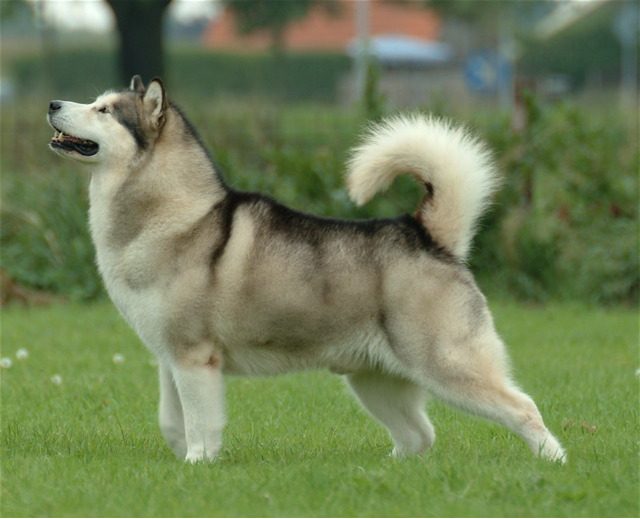
Which Mendelian variants matter most for Alaskan Malamutes?
The Mendelian-disease table above lists variants screened in 504 Alaskan Malamutes (Donner 2023). The breed’s carrier frequencies are lower across the board than in many other large breeds, which reflects both the smaller sample size and genuine lower prevalence of tested recessive variants. Five variants warrant the most attention; the remaining two (Degenerative Myelopathy and Factor VII Deficiency) appear at under 0.1% carrier frequency in this cohort.
Primary Ciliary Dyskinesia (NME5)
Primary Ciliary Dyskinesia in Alaskan Malamutes is an autosomal-recessive disorder of ciliary function. The variant sits in NME5 and was discovered in this breed. Affected dogs experience impaired mucociliary clearance, which predisposes to respiratory infection and can cause infertility. The condition is rare: 1.4% of Alaskan Malamutes in the Donner cohort carry one copy (n=504). Testing is available through commercial DNA labs that cover the breed-specific variant.
Cone Degeneration (OMIA:001365-9615)
Cone degeneration in Alaskan Malamutes is an autosomal-recessive retinal disorder discovered in this breed. Affected dogs lose color vision and day vision, with onset typically in early adulthood. The carrier frequency is low: 0.50% of Alaskan Malamutes in the Donner cohort carry the variant. A single at-risk dog in the phenotype-confirmation dataset showed clinical signs, giving the variant a maximum penetrance estimate of 100% (Donner 2023, n=1). Testing exists; screening is valuable for breeding stock.
Early-Onset Progressive Polyneuropathy (OMIA:002120-9615)
Early-onset progressive polyneuropathy in Alaskan Malamutes is an autosomal-recessive neurological disorder discovered in the Greyhound but present in other breeds. Affected dogs develop progressive weakness and loss of motor control in the hind limbs, typically manifesting in puppyhood or early adolescence. The carrier frequency in Alaskan Malamutes is 0.89% (Donner 2023, n=504). Testing is available and is relevant for breeding-stock screening given the early onset and progressive nature.
MDR1 Medication Sensitivity
Medication sensitivity in Alaskan Malamutes is an autosomal-dominant condition caused by a variant in ABCB1 (commonly called MDR1), the gene encoding a drug-efflux transporter. Dogs with one or two copies are hypersensitive to certain medications, particularly ivermectin (used for parasite prevention and treatment) and some chemotherapy agents. The variant is extremely rare in Alaskan Malamutes: 0.20% of the Donner cohort carry it (n=504). Testing is available and is most relevant for owners planning to use ivermectin-based parasite prevention.
Dilated Cardiomyopathy risk factor (PDK4-related)
Dilated cardiomyopathy risk in Alaskan Malamutes is associated with a variant labeled PDK4-related in the Donner panel, a gene first characterized in Doberman cardiomyopathy research. The OMIA entry for this risk factor was discovered in the Doberman Pinscher but is present across breeds. the PDK4-related variant shows autosomal-dominant inheritance with incomplete penetrance. Carrier frequency in Alaskan Malamutes is 0.30% (Donner 2023, n=504). Not every carrier develops clinical DCM. Testing is available; cardiac screening (echocardiography) is prudent for known carriers or breeding stock, though the rarity of the variant in this breed makes it a lower-priority screening target than in Dobermans.
How should I test my Alaskan Malamute?
A targeted panel covering Primary Ciliary Dyskinesia, cone degeneration, early-onset progressive polyneuropathy, and MDR1 is the high-yield approach for breeding stock. The Siberian Husky is the Alaskan Malamute’s closest genetic relative by PC-corrected distance (12.69, sniff.world atlas). Comparing health resources between the two breeds is useful.
What should I feed an Alaskan Malamute?
Alaskan Malamutes are large-breed working dogs built for sustained cold-weather labor, and their feeding needs reflect that history. Growth rate and joint development are the two anchoring decisions: the breed goes from newborn to 95 pounds in less than two years, and the carrier frequency for hip dysplasia in large sled breeds is non-trivial. Neither genetic nor epidemiological data specific to Alaskan Malamutes exists in the published literature, so the framework here draws from large-breed principles and the breed’s functional demands.
Large-breed puppy formula with controlled calcium is non-negotiable. Alaskan Malamutes reach adult size at 18 to 24 months. During that window, excessive calcium or an inverted calcium-to-phosphorus ratio can disrupt proper bone and joint ossification. The NRC 2006 recommendation for large-breed puppies is a calcium-to-phosphorus ratio between 1.1:1 and 2:1, with absolute calcium content between 0.8% and 1.7% on a dry-matter basis. A breeder or veterinarian experienced with the breed can point to formulations that hit those targets. Feeding oversized portions or adding calcium supplements during growth is common and counterproductive.
Adult maintenance should match the dog’s actual activity level, not the breed’s historical one. A pet Malamute in a suburban home has different caloric needs than a sled dog working six hours daily. The breed’s strong prey drive and food motivation mean weight gain is easy and metabolically costly. Joint stress from excess body weight accelerates hip and elbow wear. Once adult, feed to condition (you should be able to feel ribs without pressing hard), not to a predetermined cup volume.
The cardiac signal in Alaskan Malamutes is not yet well-characterized. Dilated cardiomyopathy occurs in large breeds and the PDK4 risk variant exists in the breed at very low frequency (0.30%, Donner 2023, n=504). The FDA’s 2018 grain-free advisory named several breeds at elevated risk; Alaskan Malamutes were not prominently featured. Until breed-specific cardiac data accumulates, a grain-inclusive adult formulation with documented taurine content is the conservative choice. Annual or biennial echocardiography is reasonable for breeding stock or dogs with a known PDK4 variant.
What we don’t know
The Alaskan Malamute atlas contains only 23 dogs, the smallest sample in this generation of the study. This means lifespan medians, disease prevalence, and longevity outliers are not yet stable. The cited life expectancy of 11.3 years (McMillan 2024 / VetCompass, n=1,980) is instructive but carries low confidence; a second atlas cohort would meaningfully change that number.
Genetic diversity rank 58 of 107 breeds places Alaskan Malamutes in the middle of the bottleneck distribution, neither tight nor expansive. The breed’s founder cohorts are small (Hayward 2016 cohort: 12 dogs; Spatola cohort: 10 dogs). What this means for hidden recessive load is unknown. As the atlas grows, hidden recessives discovered in other breeds will clarify whether Alaskan Malamutes carry similar variants at subclinical frequency.
The Donner 2023 sample size for Alaskan Malamutes is 504, adequate for common variants but underpowered for rare ones. Variants present at under 1% confidence intervals are wide. Primary Ciliary Dyskinesia and cone degeneration may be more or less frequent than the initial estimates suggest.
Frequently asked questions about Alaskan Malamutes
How long do Alaskan Malamutes live? Cited life expectancy is 11.3 years (McMillan 2024 / VetCompass, n=1,980, 95% CI 11.1 to 11.8). Individual variation is high; some Malamutes live into their mid-teens while others do not reach twelve. Giant-breed lifespan is generally shorter than in smaller breeds.
What is the most common genetic disease in Alaskan Malamutes? Primary Ciliary Dyskinesia is the highest-frequency Mendelian variant in the breed’s testing cohort, at 1.4% carrier frequency (Donner 2023, n=504). The condition affects ciliary function and is rare in the homozygous state. Carriers (one copy) are not expected to develop the disease under autosomal-recessive inheritance.
Are Alaskan Malamutes prone to hip dysplasia? Hip dysplasia risk is inherent to large breeds, including Alaskan Malamutes. Breed-specific prevalence data is not yet published. The Orthopedic Foundation for Animals maintains breed statistics; current evaluation counts and dysplasia rates are available at OFA.org. Controlled-growth puppies and lean adult condition reduce risk.
Should I do a DNA test on my Alaskan Malamute? For breeding stock, a panel covering Primary Ciliary Dyskinesia, cone degeneration, early-onset progressive polyneuropathy, and MDR1 is worthwhile. Pet owners with no breeding plans can skip genetic testing unless a specific condition is suspected or a sibling or parent is affected.
What should I feed my Alaskan Malamute puppy? A large-breed puppy formulation with controlled calcium (0.8% to 1.7% dry-matter basis) and a calcium-to-phosphorus ratio between 1.1:1 and 2:1 is the standard recommendation (NRC 2006). Avoid free-feeding; portion-feed to controlled growth. Your veterinarian or a breed-club mentor can recommend specific brands that meet these targets.
Do Alaskan Malamutes need grain-free food? No. Grain-inclusive diets are nutritionally adequate and are the conservative default. The FDA’s 2018 advisory on grain-free food and dilated cardiomyopathy did not highlight Alaskan Malamutes as a high-risk breed, but large-breed cardiac health is important. A grain-inclusive formulation with documented taurine content is prudent.
What is the Alaskan Malamute’s closest genetic relative? The Siberian Husky, with a PC-corrected genetic distance of 12.69 (sniff.world atlas). Comparing health resources and screening recommendations between the two breeds is useful; both are large northern sled-dog breeds with overlapping susceptibilities.
Are there any medications my Alaskan Malamute should avoid? MDR1 sensitivity is extremely rare in Alaskan Malamutes (0.20% carrier frequency), but if your dog carries the variant, ivermectin (found in some heartworm preventatives and parasite treatments) and certain chemotherapy agents should be avoided or used with caution. DNA testing will clarify this. Discuss medication choices with your veterinarian, especially before parasite prevention or cancer treatment.