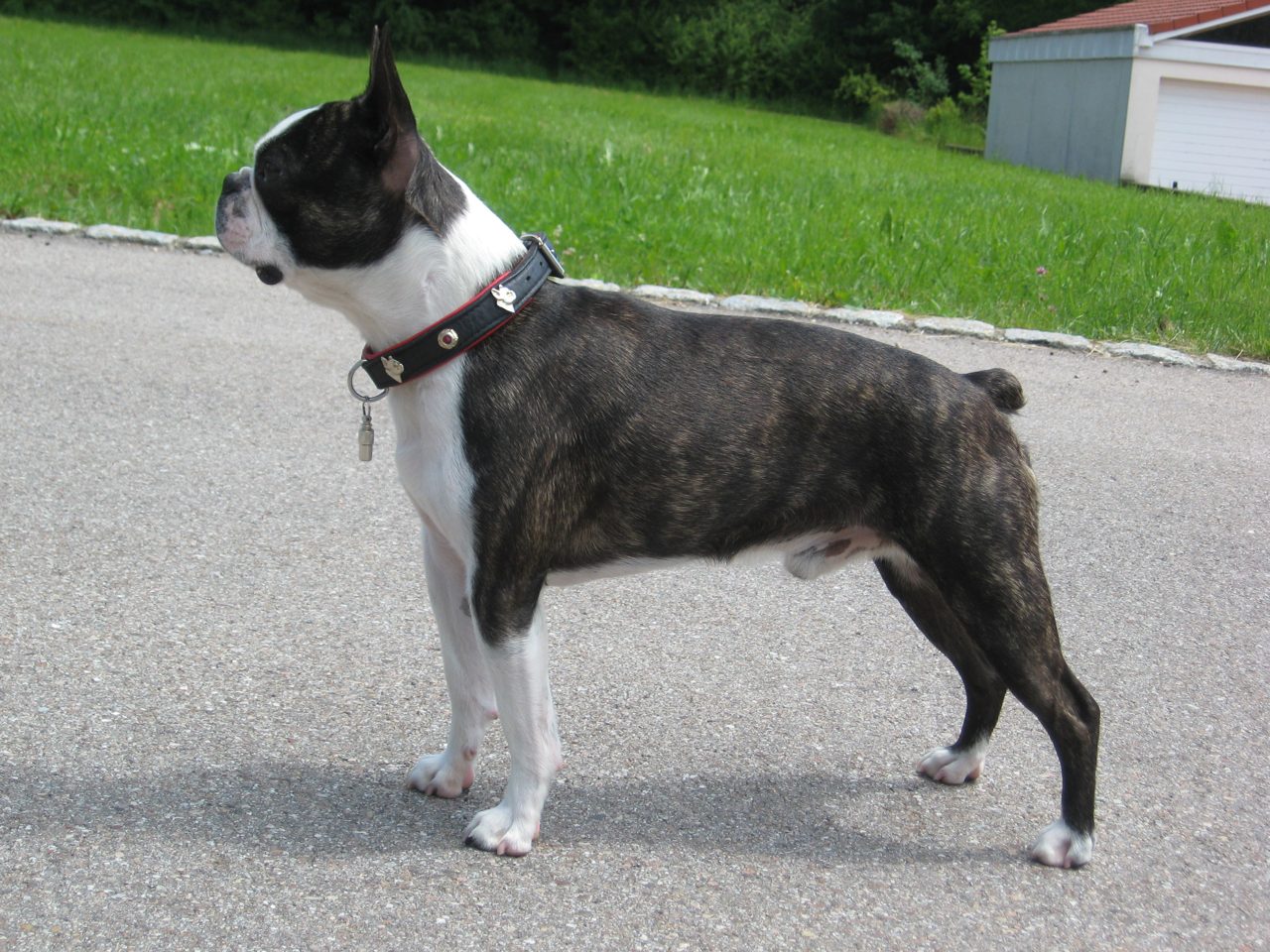
Which Mendelian variants matter most for Boston Terriers?
The Mendelian-disease table above lists variants screened in 3,702 Boston Terriers (Donner 2023). Four variants define the breed’s genetic-disease landscape, with two carrying substantially higher risk.
Dilated Cardiomyopathy risk factor (PDK4-related)
Dilated cardiomyopathy in Boston Terriers is an autosomal-dominant-with-incomplete-penetrance cardiac condition discovered in Doberman Pinschers and now identified in Boston Terriers. the PDK4-related variant predisposes to progressive weakening of the heart muscle. Affected dogs may develop exercise intolerance, coughing, or syncope. 2.8% of Boston Terriers in the Donner cohort carry the variant (n=3,702). Not every carrier develops clinical disease, which is why penetrance is incomplete.
Testing is available through commercial panels. Annual echocardiography is prudent for PDK4-positive dogs and their close relatives.
Chondrodystrophy and Intervertebral Disc Disease Risk (CDDY)
Chondrodystrophy and Intervertebral Disc Disease Risk in Boston Terriers is caused by the FGF4 retrogene insertion. The FGF4 retrogene allele is present at very high frequency in the breed: 89% on CFA18 and 97% on CFA12 in the morphology locus data. These are population-level allele frequencies, separate from the Donner 2023 Mendelian carrier frequency of 2.0% for the specific CDDY insertion variant. The classical chondrodystrophy phenotype, shortened limbs, is not the Boston Terrier’s visible standard. The consistent expression of concern for Boston Terriers is intervertebral disc disease risk, not limb morphology.
2.0% of Boston Terriers in the Donner cohort carry the additional autosomal-dominant CDDY insertion variant (n=3,685). The breed’s existing FGF4 load is already high; the CDDY contribution is modest by frequency but adds to disc-disease vulnerability. Testing exists. Owners of affected dogs should understand that disc herniation can occur throughout the spine and that spinal screening before breeding is prudent.
Degenerative Myelopathy (DM)
Degenerative myelopathy in Boston Terriers is an autosomal-recessive-with-incomplete-penetrance neurological disease caused by a variant in SOD1. Affected dogs develop progressive spinal-cord degeneration starting in the hind limbs, typically showing weakness, incoordination, and eventual paralysis. 7.7% of Boston Terriers in the Donner cohort carry one copy (n=3,702). The disease is rare but serious when it manifests.
Testing is available. Testing identifies heterozygous carriers and homozygous-affected dogs separately. Breeding recommendations favor avoiding carrier-by-carrier pairings.
Canine Multifocal Retinopathy 1 (CMR1)
Canine Multifocal Retinopathy 1 in Boston Terriers is an autosomal-recessive eye condition discovered in Mastiff-related breeds and now identified in Boston Terriers. The variant causes multiple areas of retinal dysfunction. 7.5% of Boston Terriers carry one copy (n=3,702). Importantly, Donner 2023 found zero of one at-risk homozygous dog phenotype-confirmed (max penetrance 0%), meaning clinical expression in Boston Terriers remains unconfirmed despite the variant’s presence.
Testing is available. The low confirmed penetrance in this breed suggests the condition may be less clinically significant in Boston Terriers than in other breeds, but affected dogs warrant ophthalmologic screening.
How should I test my Boston Terrier?
A breed-specific panel from a CLIA-accredited lab is the high-yield path. The minimum useful set for Boston Terriers is PDK4 (dilated cardiomyopathy risk), the CDDY insertion, SOD1 (degenerative myelopathy), CMR1, SLC3A1 (cystinuria), and screening for craniomandibular osteopathy if any joint-swelling history is present. Ask your lab which panel covers FGF4 retrogene status on both CFA18 and CFA12, since Boston Terriers carry both at elevated frequency.
What should I feed a Boston Terrier?
Feeding a Boston Terrier well means feeding around the breed’s known genetic vulnerabilities and its brachycephalic anatomy. Boston Terriers cannot pant efficiently, which means heat-of-the-day exercise is dangerous and meal timing matters more than it does for most breeds. The breed also carries elevated risk for both cardiac disease (2.8% PDK4 carrier frequency, Donner 2023, n=3,702) and intervertebral disc disease (97% FGF4 retrogene frequency on CFA12), which shapes the food strategy.
Grain-free, pulse-heavy diets carry cardiac risk for this breed. The FDA’s 2018 advisory flagged an association between grain-free, legume-heavy diets and dilated cardiomyopathy across multiple breeds (FDA 2018 DCM advisory). Boston Terriers meet both criteria. The conservative default is a grain-inclusive, taurine-supplemented adult formulation from a manufacturer that runs feeding trials. Taurine adequacy should be confirmed with your veterinarian or a board-certified veterinary nutritionist.
Meal timing and ambient temperature are non-negotiable. Boston Terriers should eat their largest meal in cooler parts of the day (early morning or evening), never in heat. Smaller, more frequent meals reduce the risk of gastric dilatation and also help stabilize energy throughout the day.
Joint support and weight management prevent disc-disease escalation. The breed’s 97% FGF4 retrogene carrier frequency means disc disease is a breed-typical vulnerability. Adult-life weight should stay at the lean end of the breed standard. Weight management and controlled activity are the most evidence-based approaches for dogs with early disc-disease signs. Starting joint-support supplements in middle-aged Boston Terriers with any spinal-pain history is a common clinical practice, though individual benefit varies. Omega-3 fatty acid supplementation (EPA and DHA) is commonly recommended for joint support; consult your veterinarian for appropriate dosing.
Sodium and cardiac health. If a Boston Terrier has developed a cardiac murmur or been diagnosed with dilated cardiomyopathy, sodium restriction becomes important. The appropriate sodium threshold varies by cardiac stage and should be guided by your veterinary cardiologist. Do not restrict sodium without cardiac diagnosis; healthy dogs need adequate sodium for osmotic balance.
What we don’t know
The mechanism linking PDK4 variants to incomplete-penetrance dilated cardiomyopathy in Boston Terriers is not fully resolved. We do not know which Boston Terrier carriers will develop clinical cardiac disease and which will remain asymptomatic throughout life. Annual echocardiography for PDK4-positive dogs is the prudent path until more data emerges.
Craniomandibular osteopathy penetrance in Boston Terriers is extremely low (1 of 11 at-risk dogs phenotype-confirmed, max 9%, Donner 2023). The variant is present at 0.92% carrier frequency (n=3,702), but clinical expression in the breed appears rare. We do not yet have a clear explanation for why this variant, common in Scottish and West Highland White Terriers, causes so little disease in Boston Terriers.
The Atlas contains only 31 Boston Terriers, which is a small cohort. Longevity patterns and rare-disease epidemiology may shift as more Boston Terriers enter the database. Longevity patterns, rare-disease epidemiology, and founder-bottleneck effects may shift as more Boston Terriers enter the database. The breed’s genetic diversity rank of 80 of 107 suggests tighter founder structure than average; additional data will clarify whether this has contributed to disease frequency.
Frequently asked questions about Boston Terriers
Are Boston Terriers prone to heart disease? Boston Terriers carry the PDK4 dilated cardiomyopathy risk variant at 2.8% (Donner 2023, n=3,702). Not every carrier develops clinical disease, but annual echocardiography is recommended for PDK4-positive dogs starting in middle age.
What is the most common genetic issue in Boston Terriers? Degenerative myelopathy carries the highest frequency at 7.7% carrier rate (Donner 2023, n=3,702). A carrier with one copy is not itself at risk; the disease shows up in dogs with two copies, and even then how often it actually develops is genuinely debated, so a result here is a marker to track in breeding, not a verdict on a dog. Canine Multifocal Retinopathy 1 is also at 7.5% carrier frequency and is generally a mild, non-progressive finding in the breed.
Do Boston Terriers get back problems? Boston Terriers carry the FGF4 retrogene at very high frequency (89% on CFA18, 97% on CFA12), which increases intervertebral disc disease risk. Weight management, avoiding jumping from heights, and early treatment of any spinal pain reduce severity.
How long do Boston Terriers live? Cited life expectancy is 11.8 years (McMillan 2024 / VetCompass, n=1,984, 95% CI 11 to 12.2). Individual lifespan varies with cardiac and neurological health, weight management, and access to preventive screening.
Can I do a DNA test to know if my Boston Terrier will get degenerative myelopathy? Testing identifies carrier status and homozygous-affected dogs. Carriers have a risk of producing affected offspring if bred to another carrier. Homozygous-affected dogs have the genetic predisposition but may never show symptoms due to incomplete penetrance; screening for early neurological signs is prudent.
What is the best diet for a Boston Terrier? Grain-inclusive, taurine-supplemented formulations are safest given the breed’s cardiac vulnerability and brachycephalic anatomy. Feed larger meals in cool parts of the day, avoid grain-free diets, and keep weight at the lean end of the breed standard to support joint health.
Are Boston Terriers good with children? Boston Terriers are companion dogs with historically stable temperament. Individual socialization and training matter more than breed predisposition. Their small size and brachycephalic anatomy mean they overheat easily, so play sessions should be brief and in cool conditions.
Do Boston Terriers shed a lot? Boston Terriers have short, smooth coats and shed moderately year-round, with heavier shedding during seasonal coat blows. Regular brushing reduces loose hair in the home.