snıff

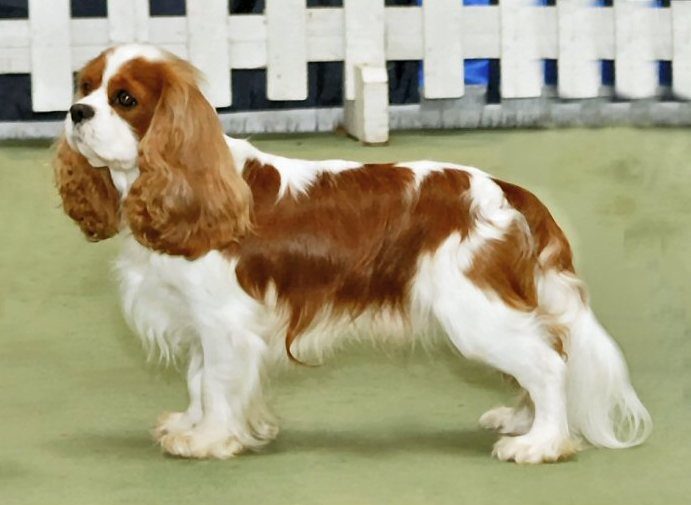
Cavalier King Charles Spaniel

102 Cavalier King Charles Spaniels in the atlas. Every number on this page has a source.

Population-genetic snapshot of Cavalier King Charles Spaniels in the Sniff Atlas, source-graded Mendelian carrier frequencies from Donner 2023, and nutrition guidance tied to the genetic findings above.

What the atlas says about Cavalier King Charles Spaniel

In the atlas, the Cavalier King Charles Spaniel clusters consistently as Cavalier King Charles Spaniel (100% of the 102 dogs here). At the trait loci, FGF4_retrogene_CFA12 runs lower than average (0% here vs 80%); ADAMTS17 runs higher than the atlas average (97% here vs 54%).

Ranks 11 of 107 on the bottleneck severity scale, well into the upper quartile of population contraction.

Closest genetic neighbors in the atlas: American Cocker Spaniel, English Setter, English Springer Spaniel, Wirehaired Pointing Griffon, and Gordon Setter. AKC classifies the breed in the toy group; the corrected top-10-PC distance places it nearer to the sporting group. This is one of the atlas's strong-tier AKC mismatch findings.

Median lifespan is 10.0 years, about 3.0 years shorter than a typical dog of 6.7 kg, one of the larger gaps in the atlas.

Genetic dimensions · CanVAS atlas

What the genome says about Cavalier King Charles Spaniel

Computed from the 18,477 research dogs in the Atlas.

Dogs in the Atlas
102Founders
51 from Hayward2016, 34 from Momozawa, 10 from Spatola
Genetic diversity
0.24Tight
Mean heterozygosity across the breed. Ranks 11th most genetically tight of 107 ranked breeds.
Cluster structure
Splits into two genetic sub-populations
Intra-breed RMS distance: 26.75 · likely working/show-line, regional, or kennel lineage split.
Nearest genetic relatives
  1. American Cocker Spaniel5.87
  2. English Setter7.67
  3. English Springer Spaniel10.45
  4. Wirehaired Pointing Griffon11.01
  5. Gordon Setter11.29
Top-10 PC corrected Euclidean. Lower = closer.
How long they live
10.0years (atlas median)
Trait genetics
Allele frequencies at named morphology loci

Frequency of the alternate allele in this breed at each locus's representative SNP.

Body size
IGF197%
HMGA272%
SMAD233%
LCORL100%
STC297%
ADAMTS1797%
Leg length
FGF4·CFA1872%
FGF4·CFA121%
Coat
RSPO228%
FGF532%
KRT7194%
MC1R29%
Ear set
MSRB397%
Skull shape
BMP370%
SMOC2100%
What you see when you look at a Cavalier King Charles Spaniel

What does the genome say about how a Cavalier King Charles Spaniel looks?

Cavalier King Charles Spaniels look the way they do because of a small set of fixed and near-fixed morphology genes that, taken together, define the visible breed. Each translation below pairs the gene with the trait an owner actually sees, the breed's allele frequency at that locus, and a one-clause causal phrase.

Size and build

IGF1 is near-fixed at 97% for the small-body allele, which keeps the breed compact relative to its working-line ancestors.

HMGA2 sits at 72%. HMGA2 is a chromosome-10 size locus that acts together with IGF1, and intermediate frequencies reflect partial commitment to the dominant size variant.

SMAD2 sits at 33% at the chromosome-7 height locus.

LCORL is near-fixed at 100%, the NCAPG/LCORL height locus that is one of the strongest single contributors to canine body size.

STC2 is near-fixed at 97%, modulating growth-axis signaling toward the breed's body-size set point.

ADAMTS17 is at 97%, near-fixed for the size variant.

Leg length

The FGF4 retrogene on chromosome 18 sits at 72%. This is the leg-length variant. The intermediate frequency means some dogs in this breed carry the short-legged allele and some do not.

The FGF4 retrogene on chromosome 12 is at 1%, leaving most of this breed clear of the chondrodystrophic intervertebral disc disease risk.

Coat type, length, and color

RSPO2 is at 28% for the furnishings allele. The breed does not carry the eyebrows-and-mustache pattern of Wheatens, Schnauzers, or wire-haired terriers.

FGF5 sits at 32% for the long-coat variant. Coat length is influenced by other loci as well, so intermediate FGF5 frequencies do not always correspond to intermediate visible coat lengths.

KRT71 is near-fixed at 94% for the wavy/curly variant. Coat curl phenotype varies across breeds at this fixation depending on modifier loci, and visible expression is not always curled even when the locus is fixed.

MC1R is at 29% at the representative SNP, leaving the breed in the black-to-brown coat range under the dominant E allele.

Ears

MSRB3 is at 97% for the drop-ear allele, the genetic basis of the breed's signature dropped ear set.

Skull shape

BMP3 sits at 70%, contributing to the breed's moderate, mesaticephalic head shape rather than the extreme brachycephalic form.

SMOC2 is at 100%, the major locus contributing to the breed's brachycephalic face shape.

Mendelian-disease genetics

What genetic diseases do Cavalier King Charles Spaniels carry?

From a panel of 250 Mendelian-disease variants screened in 1,054,293 dogs (Donner et al. 2023), Cavalier King Charles Spaniels carry 14 of them at observable frequency. Carrier frequency is not clinical risk. Most recessive variants require two copies for disease expression; many dominant variants show incomplete penetrance. Read this as a population fingerprint of what's in the gene pool, not a per-dog prediction.

n = 2,232 dogs · 1 variant tested · OMIA:000157-9615 · omia.org →
Degenerative Myelopathy (DM)
Autosomal recessive (Incomplete penetrance)
high 51.0%
n = 2,242 dogs · 1 variant tested · OMIA:000263-9615 · omia.org →
Episodic Falling (EF)
Autosomal recessive
low 6.7%
n = 2,243 dogs · 1 variant tested · OMIA:001592-9615 · omia.org →
Skeletal Dysplasia 2 (SD2)
Autosomal recessive
low 1.5%
n = 2,243 dogs · 1 variant tested · OMIA:001772-9615 · omia.org →
n = 2,243 dogs · 1 variant tested · OMIA:001298-9615 · omia.org →
Prekallikrein Deficiency
Autosomal recessive
low 0.13%
n = 2,243 dogs · 1 variant tested · OMIA:000819-9615 · omia.org →
Cone-Rod Dystrophy (cord1-PRA/crd4)
Autosomal recessive (Incomplete penetrance)
low <0.1%
n = 2,242 dogs · 1 variant tested · OMIA:001432-9615 · omia.org →
Exercise-Induced Collapse (EIC)
Autosomal recessive (Incomplete penetrance)
low <0.1%
n = 2,242 dogs · 1 variant tested · OMIA:001466-9615 · omia.org →
Factor VII Deficiency
Autosomal recessive
low <0.1%
n = 2,243 dogs · 1 variant tested · OMIA:000361-9615 · omia.org →
low <0.1%
n = 2,243 dogs · 1 variant tested · OMIA:001514-9615 · omia.org →
n = 2,243 dogs · 1 variant tested · OMIA:001400-9615 · omia.org →
Primary Lens Luxation (PLL)
Autosomal recessive
low <0.1%
n = 2,243 dogs · 2 variants tested · OMIA:000588-9615 · omia.org →
Source: Donner J et al. 2023. Frequencies of inherited disease variants in dogs. PLOS Genetics 19(2):e1010651 · Evidence: Limited (DTC ascertainment, tag-SNP proxy) · Confounding MEDIUM · License CC-BY-4.0 · Phene IDs from OMIA (Sydney School of Veterinary Science, The University of Sydney; DOI 10.25910/2AMR-PV70).
Sample size in this breed: 2,243 dogs from the Donner 2023 cohort.

Which Mendelian variants matter most for Cavalier King Charles Spaniels?

The Mendelian-disease table above lists variants screened in 2,243 Cavaliers (Donner 2023). Two dominate by carrier frequency and impact.

Chondrodystrophy and Intervertebral Disc Disease Risk (CDDY)

Chondrodystrophy and Intervertebral Disc Disease Risk in Cavaliers is caused by an FGF4 retrogene insertion. The variant is autosomal dominant and present in 99.0% of Cavaliers (Donner 2023, n=2,232). Let that settle for a moment. Nearly every Cavalier alive carries it.

The classical chondrodystrophy phenotype, shortened limbs, does not appear in Cavaliers the way it does in Dachshunds or Corgis. Cavaliers carry the CDDY genotype but the breed standard describes normal limb proportions. Shortened-limb expression, typical in Dachshunds, is not a feature of the Cavalier standard despite the high variant frequency. The consistent expression in Cavaliers is intervertebral disc disease (IVDD) risk, not limb morphology. A Cavalier’s spine is vulnerable to disc herniation from early adulthood onward.

Testing exists but is most useful for understanding risk stratification in a litter. The variant is so prevalent in the breed that a “clear” Cavalier is statistically unlikely. Owners should understand that spine health, avoiding jumping from furniture, managing weight, watching for acute hind-limb weakness, matters more than the genetic test result.

Degenerative Myelopathy (DM)

Degenerative myelopathy in Cavaliers is a progressive spinal-cord degeneration caused by variants in the SOD1 gene. It is autosomal recessive with incomplete penetrance. Affected dogs develop hind-limb weakness that worsens over months to years, typically in middle age or later.

Cavaliers carry the disease variant at 51.0% frequency (Donner 2023, n=2,242). That means roughly one in four Cavaliers are homozygous at-risk. Not all homozygous dogs develop clinical signs, which is why the inheritance is incomplete-penetrance.

Testing is available and useful for breeding decisions. The Orthopedic Foundation for Animals maintains a searchable registry of tested dogs.

How should I test my Cavalier King Charles Spaniel?

For breeding stock, a panel covering CDDY (chondrodystrophy/IVDD), DM (degenerative myelopathy), and episodic falling is the minimum. Commercial labs including PennGen and Embark offer Cavalier-specific panels. Pet owners testing for health knowledge gain the most from DM and CDDY status; the remaining variants in the table are too rare to affect breeding decisions for most owners.

What should I feed a Cavalier King Charles Spaniel?

Feeding a Cavalier well means feeding around the breed’s dominant health constraint: mitral valve disease. The breed’s nutritional priorities shift the moment a vet first hears a murmur. Roughly half of Cavaliers develop one by age five (Häggström et al. 1992, J Small Anim Pract 33:253-258).

For Cavaliers without a diagnosed murmur, the feeding goal is joint support and cardiac precaution. The 99.0% carrier frequency for the CDDY variant (Donner 2023, n=2,232) means nearly every Cavalier carries IVDD risk despite lacking the Dachshund phenotype. A large-breed adult formulation with controlled sodium and moderate taurine content is a conservative starting point. Weight management matters: obesity accelerates both disc degeneration and valve disease.

The moment a Cavalier receives a cardiac diagnosis (murmur, arrhythmia, or echocardiographic evidence of valve disease), sodium restriction becomes the primary lever. ACVIM consensus on canine heart disease (Keene et al. 2019, DOI:10.1111/jvim.15402) recommends dietary sodium below 0.3% on a dry-matter basis for dogs with clinical signs of mitral valve disease. A therapeutic cardiac diet from a major manufacturer, Royal Canin Cardiac, Hill’s h/d, or Purina Probalance, is the high-compliance path. These formulations also contain taurine and L-carnitine at levels studied in cardiac disease.

Avoid grain-free diets in this breed. The FDA’s 2018 and 2022 advisories documented dilated cardiomyopathy cases linked to grain-free formulations. Cavaliers were not listed in the breed-by-breed breakdown as heavily as Goldens, but the breed’s existing mitral valve disease rate means cardiac risk tolerance is already low. A grain-inclusive formulation with named meat as the first ingredient and AAFCO certification is the practical standard.

Puppy feeding sets the stage for adult joint health. A controlled-growth puppy formula with calcium 1.0 to 1.8% on a dry-matter basis and a calcium-to-phosphorus ratio between 1.1:1 and 2:1 (NRC 2006) supports normal skeletal development without accelerating hip dysplasia or exacerbating disc-herniation risk. Growth rate matters: slow, steady growth is gentler on a spine vulnerable to IVDD.

What we don’t know

The penetrance and age-of-onset picture for Cavalier IVDD remains incomplete. We know the FGF4 retrogene sits at 99% frequency. We do not yet know which Cavaliers in that 99% carrier pool become symptomatic and which do not. Nor do we know why some Cavaliers herniate a disc at age three and others at age twelve. Environmental modifiers, activity level, early trauma, cumulative loading, likely matter, but the published analyses have not isolated them.

Mitral valve disease is the leading cause of death in Cavaliers (Egenvall et al. 2000, J Vet Intern Med 14:295-301). The genetic and nutritional prevention strategies that might slow disease progression are uncertain. The ACVIM consensus (Keene et al. 2019, DOI:10.1111/jvim.15402) reviewed nutritional and pharmacological supports for MVD. Evidence for taurine, L-carnitine, and ACE inhibitor use before clinical signs is mixed. The breed-club health programs have focused on early screening (annual cardiac auscultation and echocardiography) rather than prevention. Prevention mechanisms remain an open question.

The atlas lifespan median for Cavaliers is 10.0 years, which is lower than many toy and small breeds. Breed-club health surveys report similar figures, placing median survivorship around 10 years. The drivers of early mortality, mitral valve disease, IVDD-related paralysis, sudden cardiac events, are known. Whether breeding strategy, nutrition, or screening protocols could extend the median is not yet settled.

Frequently asked questions about Cavalier King Charles Spaniels

Are Cavaliers prone to heart disease? Yes. Mitral valve disease is the most common cardiac condition in the breed (Egenvall et al. 2000, J Vet Intern Med 14:295-301). The breed-club health programs recommend annual cardiac screening (auscultation and echocardiography) beginning in young adulthood. Early murmurs often precede clinical signs by years, and the screening window matters for prognosis.

How long do Cavaliers live? The atlas lifespan median is 10.0 years. The breed-club estimate similarly indicates a median survivorship of approximately 10 years. This is shorter than many toy breeds. Cardiac disease, intervertebral disc disease, and sudden mortality account for much of the early loss.

What is the most common genetic disease in Cavaliers? Chondrodystrophy and Intervertebral Disc Disease Risk (CDDY). The variant is present in 99.0% of Cavaliers (Donner 2023, n=2,232). The phenotype in Cavaliers is spine vulnerability, not limb shortening. Intervertebral disc herniation can strike at any age, with onset often reported in dogs between three and eight years old.

Should I do a DNA test on my Cavalier? For breeding stock, yes. Test for CDDY (chondrodystrophy/IVDD) and degenerative myelopathy (DM). For pet owners, DM testing can clarify disease risk; CDDY testing is less informative because the variant is nearly ubiquitous.

What is the best diet for a Cavalier with a heart murmur? A therapeutic cardiac diet with sodium below 0.3% dry-matter basis, supplemented with taurine and L-carnitine. Royal Canin Cardiac, Hill’s h/d, and Purina Probalance are AAFCO-certified options. Your cardiologist may recommend a specific formulation. Sodium restriction is the primary dietary lever once cardiac disease is present (Keene et al. 2019, DOI:10.1111/jvim.15402).

Can I feed my Cavalier grain-free food? Not recommended. The FDA’s 2018 and 2022 advisories identified dilated cardiomyopathy cases linked to grain-free diets. Cavaliers already carry elevated cardiac risk. A grain-inclusive formulation with taurine supplementation is the conservative default.

Why do Cavaliers get intervertebral disc disease? Cavaliers carry the FGF4 retrogene (CDDY variant) at 99.0% frequency. The variant increases disc degeneration risk despite Cavaliers showing normal limb length. Environment likely matters, jumping, trauma, obesity, but the genetic vulnerability is foundational. Weight management and spine-gentle activity help but do not eliminate risk.

Should my Cavalier puppy eat large-breed or small-breed formula? Large-breed puppy formula with controlled calcium (1.0 to 1.8% DM) and a 1.1:1 to 2:1 calcium-to-phosphorus ratio supports normal growth and reduces joint stress. Slow growth is gentler on a spine vulnerable to disc herniation. Switch to an adult maintenance diet at 9 to 12 months per your vet’s guidance.

The data behind this page

Where every number on this page came from.

This page draws on three primary data sources. Carrier frequencies for the Mendelian section come from Donner et al. 2023 (CC-BY-4.0). We grade these data at evidence Limited because the cohort is a direct-to-consumer ascertainment, which biases toward owners who chose to test their dogs. The panel also uses tag-SNP proxies for some variants rather than direct causal-variant assays. Limited is a study-design grade, not a quality grade: the Donner cohort is the largest open canine-genotype dataset in existence and we are grateful for it. We rate the confounding MEDIUM.

Population-genetic dimensions (heterozygosity, intra-breed PCA distance, nearest neighbors, trait-locus frequencies) come from CanVAS (Brundage 2026), harmonized through the Sniff Atlas. The exact release date and verification commit are pinned at the bottom of the page so a researcher can trace a number back to a specific snapshot. The disease-gene-variant graph comes from OMIA (Online Mendelian Inheritance in Animals; Nicholas, Tammen, and the Sydney Informatics Hub at the Sydney School of Veterinary Science, The University of Sydney; retrieved April 2026, DOI 10.25910/2AMR-PV70).

What this page does not yet have. Inheritance modes and per-disease penetrance evidence from Donner 2023 are now in the structured data for every variant the panel covers. Mondo, OMIM, Ensembl, and HGNC cross-references on gene pages remain pending — they arrive in December 2026 alongside the imputed 9.67M-variant CanVAS dataset via the OMIA SQL dump absorption. Until then, gene IDs carry NCBI Gene and OMIA phene URLs only; the wider human-homolog and disease-ontology cross-reference set fills in with that release.

How to cite this page. The computed dimensions on this page are derived from the open Sniff Atlas v1.0.1 (Gehring 2026, doi:10.5281/zenodo.20566358, CC-BY 4.0). Full citation formats including BibTeX, RIS, and CITATION.cff at sniff.world/cite.

Add your cavalier king charles spaniel to the atlas

We have 102 cavalier king charles spaniels. We do not have yours.

Every cavalier king charles spaniel added sharpens the breed's genetic neighborhood. Enrollment is free. The data stays open. The star is permanent.

Want to wait for DNA uploads?

Leave your email and we'll let you know the moment DNA uploads open for Cavalier King Charles Spaniels.

References
  1. Donner J, Anderson H, Davison S, et al. (2023). Frequency and distribution of 152 genetic disease variants in over 1,000,000 mixed-breed and purebred dogs. PLOS Genetics 19(2):e1010651. doi:10.1371/journal.pgen.1010651
  2. Brundage J, et al. (2026). CanVAS: a harmonized canine variant atlas. bioRxiv. doi:10.64898/2026.04.13.718238
  3. Nicholas, F.W., Tammen, I., & Sydney Informatics Hub. (2026). Online Mendelian Inheritance in Animals (OMIA) [dataset]. The University of Sydney. https://omia.org. doi:10.25910/2AMR-PV70 (retrieved April 2026).
Last updated
Sources: CanVAS (Brundage 2026) · Donner 2023 · OMIA