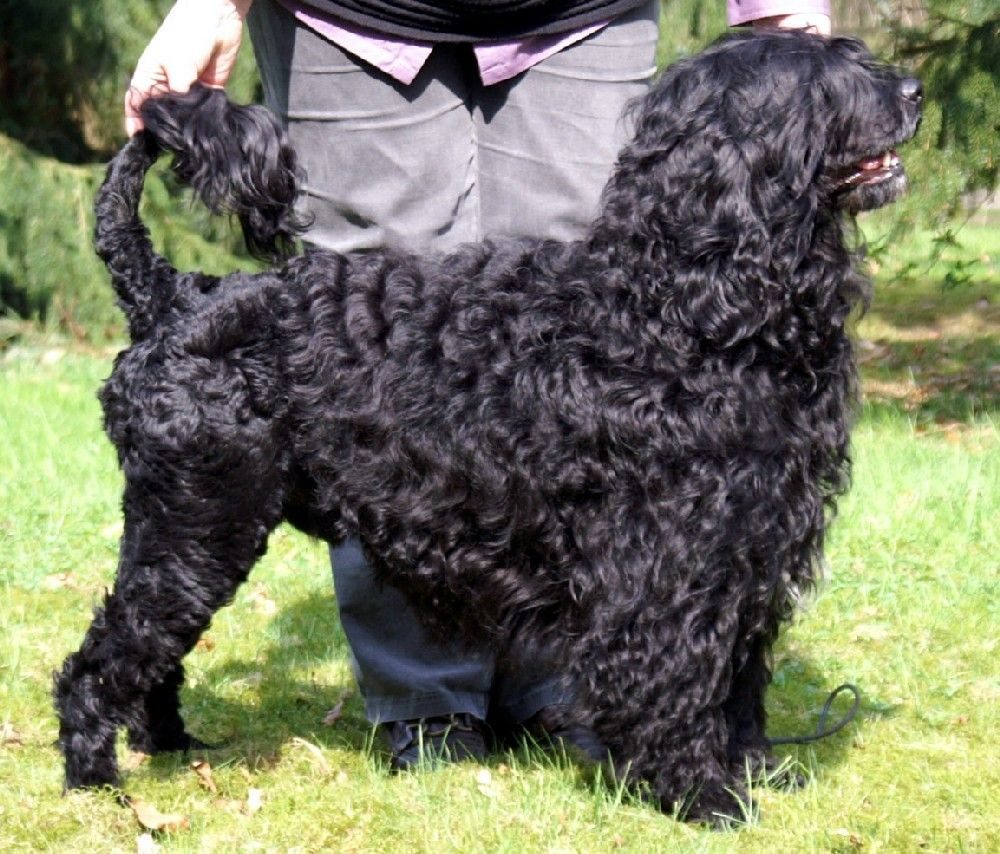
Which Mendelian variants matter most for Portuguese Water Dogs?
The Mendelian-disease table above lists variants screened in 664 Portuguese Water Dogs (Donner 2023). Four matter most by carrier frequency and penetrance.
Chondrodystrophy and Intervertebral Disc Disease Risk (CDDY)
Chondrodystrophy and Intervertebral Disc Disease Risk in Portuguese Water Dogs is caused by a dominant FGF4 retrogene insertion. Portuguese Water Dogs carry this variant at 10.4% (n=659) but do not express the classical chondrodystrophic phenotype, shortened limbs and barrel chest, that defines Dachshunds and Corgis. The breed standard shows normal leg length. The primary clinical concern in Portuguese Water Dogs is intervertebral disc disease risk, not visible limb shortening, though CDDY penetrance in this breed is not yet fully characterized.
The variant matters because it predisposes to disc herniation in middle age. Affected dogs may present with acute pain, hind-limb weakness, or paralysis. Testing is available through commercial DNA panels. Carriers should be monitored for spinal signs and managed conservatively when possible; affected dogs may require surgical decompression.
Progressive Rod-Cone Degeneration (prcd-PRA)
Progressive rod-cone degeneration in Portuguese Water Dogs is an autosomal recessive retinal condition caused by a mutation in the PRCD gene. Affected dogs typically develop night blindness in mid-life, followed by progressive day-blindness and eventual total vision loss over several years. 7.8% of Portuguese Water Dogs in the Donner cohort carry one copy (n=663).
Testing is straightforward and widely available. Two copies of the variant result in disease; two carriers can produce affected offspring. Breeders use test results to avoid carrier-by-carrier pairings.
GM1 Gangliosidosis (Discovered in the Shiba)
GM1 Gangliosidosis in Portuguese Water Dogs is an autosomal recessive neurodegenerative lysosomal storage disease. Affected dogs show progressive neurological decline, tremor, ataxia, cognitive regression, typically onset in early life. The variant is extremely rare in the breed at 0.15% carrier frequency (n=664).
Testing exists but is not routinely recommended given the rarity. Affected dogs have no treatment; management is supportive care.
Early-onset PRA (Discovered in the Portuguese Water Dog; EOPRA)
Early-onset PRA in Portuguese Water Dogs is an autosomal recessive form of progressive retinal atrophy caused by a variant specific to this breed. Affected dogs develop vision loss earlier and more rapidly than in prcd-PRA. The variant is extremely rare at less than 0.1% carrier frequency (n=664).
Testing is available but rarely needed given the rarity in the breed.
How should I test my Portuguese Water Dog?
A Portuguese Water Dog-specific panel from a CLIA-accredited lab should cover CDDY (chondrodystrophy/IVDD risk), prcd-PRA, and the breed-specific EOPRA variant. Testing for GM1 Gangliosidosis is optional given its near-absence in the breed. Breeders should prioritize CDDY and prcd-PRA status before pairing dogs.
What should I feed a Portuguese Water Dog?
Feeding a Portuguese Water Dog well means attending to the breed’s CDDY carrier frequency and the modest joint-health implications that follow. 10.4% of the breed carries the FGF4 retrogene, which predisposes to intervertebral disc disease.
Weight management and joint support are the keystones. Portuguese Water Dogs were bred for full-day water work in the Atlantic, and their metabolism expects sustained activity. A pet Portuguese Water Dog eating a sedentary maintenance diet is being overfed for their actual job. Overweight predisposes to disc herniation; lean body condition is protective. The NRC 2006 calcium-to-phosphorus ratio guideline (1.1:1 to 2:1 for adult dogs) applies here as it does in all breeds, but the discipline of holding weight in the normal range matters more in carriers of CDDY.
A grain-inclusive, protein-appropriate adult formula is the conservative default. The breed has no documented FDA-flagged diet-disease associations like those seen in some other breeds. A diet with adequate omega-3 fatty acid content (supporting joint and skin health) and appropriate caloric density for moderate activity is sufficient. Portuguese Water Dogs have a single-layer, water-resistant coat with no undercoat; occasional omega-3 supplementation may benefit dogs with dry skin, though most thrive on a balanced commercial diet.
Life-stage feeding reflects the breed’s maturity arc. A medium-breed puppy formula with controlled growth rate (calcium 1.0-1.8% dry matter, phosphorus 0.8-1.6% dry matter per NRC 2006) is appropriate during the growth window. Adult maintenance should track actual activity level. Portuguese Water Dogs who participate in dock diving, swimming, or water trials will benefit from slightly elevated protein and fat (20-25% crude protein, 12-15% crude fat) to fuel sustained work. Senior dogs should shift to lower-calorie formulations and may benefit from joint-support supplements if CDDY-related disc disease emerges.
What we don’t know
The breed’s small atlas cohort (n=42 dogs) limits our power to detect rare variants and to track long-term health outcomes across the lifespan. We do not yet have breed-specific median lifespan data from prospective follow-up studies.
CDDY penetrance in Portuguese Water Dogs is not fully characterized. The variant is present at 10.4%, but we do not know what fraction of carriers become symptomatic and at what age. The breed’s water-work heritage may modulate risk; the high activity demands in the breed’s working lineages might either protect against disc herniation through maintained spinal musculature or increase risk through impact on water entries and exits. The honest answer is we do not yet have the longitudinal data to settle this.
Cancer rates, neurological disease frequency, and other age-related conditions lack breed-specific epidemiological surveys. The breed-club health resources would be the first source for these questions, but published studies are thin.
Frequently asked questions about Portuguese Water Dogs
Are Portuguese Water Dogs good swimmers? Yes. The breed was developed along the Portuguese coast to herd fish and retrieve nets, and they have water-resistant single-layer coats and webbing between their toes. Most take naturally to water and enjoy aquatic work or play.
How long do Portuguese Water Dogs live? The Portuguese Water Dog Club of America cites a typical lifespan of 11 to 13 years (pwdca.org). The atlas cohort is too small (n=42) to establish a robust median from prospective follow-up data.
What is the most common health problem in Portuguese Water Dogs? No single condition dominates the health picture the way cancer does in some breeds. Intervertebral disc disease risk is present in 10.4% of the breed via CDDY carrier status (Donner 2023, n=659), and progressive retinal atrophy (prcd-PRA) carrier frequency is 7.8% (Donner 2023, n=663). Both are manageable with monitoring and preventive care.
Should I do a DNA test on my Portuguese Water Dog? For breeding stock, yes. A panel covering CDDY, prcd-PRA, and the breed-specific EOPRA variant is the standard of care. For pet dogs, testing answers questions about disc-disease risk and vision loss risk but does not change management unless two copies of a recessive variant are detected.
What is the best diet for a Portuguese Water Dog? A grain-inclusive adult formula matched to actual activity level is the default. Portuguese Water Dogs are prone to weight gain if overfed for a sedentary lifestyle. Lean body condition is protective against intervertebral disc disease. If your dog swims or works regularly, slightly elevated protein (20-25%) and fat (12-15%) support sustained activity.
Are Portuguese Water Dogs prone to ear infections? The breed has floppy ears and water-loving tendencies, which together create a moisture-trapping environment. Regular ear cleaning after swimming or bathing is standard preventive care. No genetic predisposition to infection has been documented in the breed-specific literature.
Do Portuguese Water Dogs need a lot of exercise? Yes. The breed was developed for full-day water work and retains that metabolic expectation. A sedentary pet Portuguese Water Dog is at higher risk of obesity and disc disease. Aim for at least an hour of sustained activity daily, ideally including swimming or retrieving.
What are Portuguese Water Dogs like with children? Portuguese Water Dogs are typically affectionate and playful with families. Their retrieving drive and water enthusiasm make them strong playmates for older children. Young puppies can be mouthy during play and benefit from supervision with toddlers, as with all energetic breed puppies.