Which Mendelian variants matter most for Vizslas?
The Mendelian-disease table above lists variants screened in 318 Vizslas (Donner 2023). Three matter most, and all three are rare in the breed. The rarity is itself important information.
Dilated Cardiomyopathy risk factor (PDK4-related)
Dilated cardiomyopathy in Vizslas is an autosomal-dominant-with-incomplete-penetrance cardiac condition. the PDK4-related variant is associated with increased risk of heart enlargement and systolic dysfunction and was first characterized in Doberman Pinschers. In Vizslas, the variant is uncommon: 1.6% carry it (n=318, Donner 2023). Not every dog with the variant develops clinical disease, which is why the inheritance is incomplete penetrance.
Testing for the PDK4-linked DCM risk variant is available through commercial canine genetics laboratories. Vizslas with a family history of early cardiac disease or unexpected syncope warrant screening. Annual or biannual echocardiography is standard monitoring for carriers.
Exercise-Induced Collapse (EIC)
Exercise-induced collapse in Vizslas is an autosomal-recessive-with-incomplete-penetrance disorder of muscle metabolism. Affected dogs experience hind-limb weakness or collapse during or immediately after intense exercise, particularly in warm conditions. The variant is rare in Vizslas: 1.6% are carriers (n=318). The penetrance signal in the Donner dataset is null; no at-risk dogs in their cohort showed phenotype-confirmed disease. This does not mean the variant is benign, it means the breed’s current carrier pool has not expressed it visibly, but it signals low immediate clinical concern.
Testing exists and is straightforward. Carriers are managed with exercise modulation and heat awareness.
Factor VII Deficiency
Factor VII deficiency in Vizslas is an autosomal-recessive clotting disorder. Affected dogs have reduced Factor VII activity and prolonged clotting times, risking excessive bleeding from trauma or surgery. 0.94% of Vizslas are carriers (n=318). The Donner penetrance data show 6 of 33 at-risk dogs with phenotype confirmation, a maximum penetrance of 18%. Most dogs with two copies do not bleed visibly.
Testing is available and inexpensive. Affected dogs are identified through routine coagulation screening before elective surgery.
How should I test my Vizsla?
A targeted panel for Vizslas should cover the PDK4-linked DCM risk variant, EIC (DNM1), and Factor VII deficiency (F7). Given the breed’s small founder cohort (Donner 2023), new variants may emerge as more dogs are tested; discuss panel options with your veterinarian. Discuss panel options with your veterinarian or a commercial genetics laboratory; the breed’s small founder cohort means new variants may emerge as more dogs are tested.
What should I feed a Vizsla?
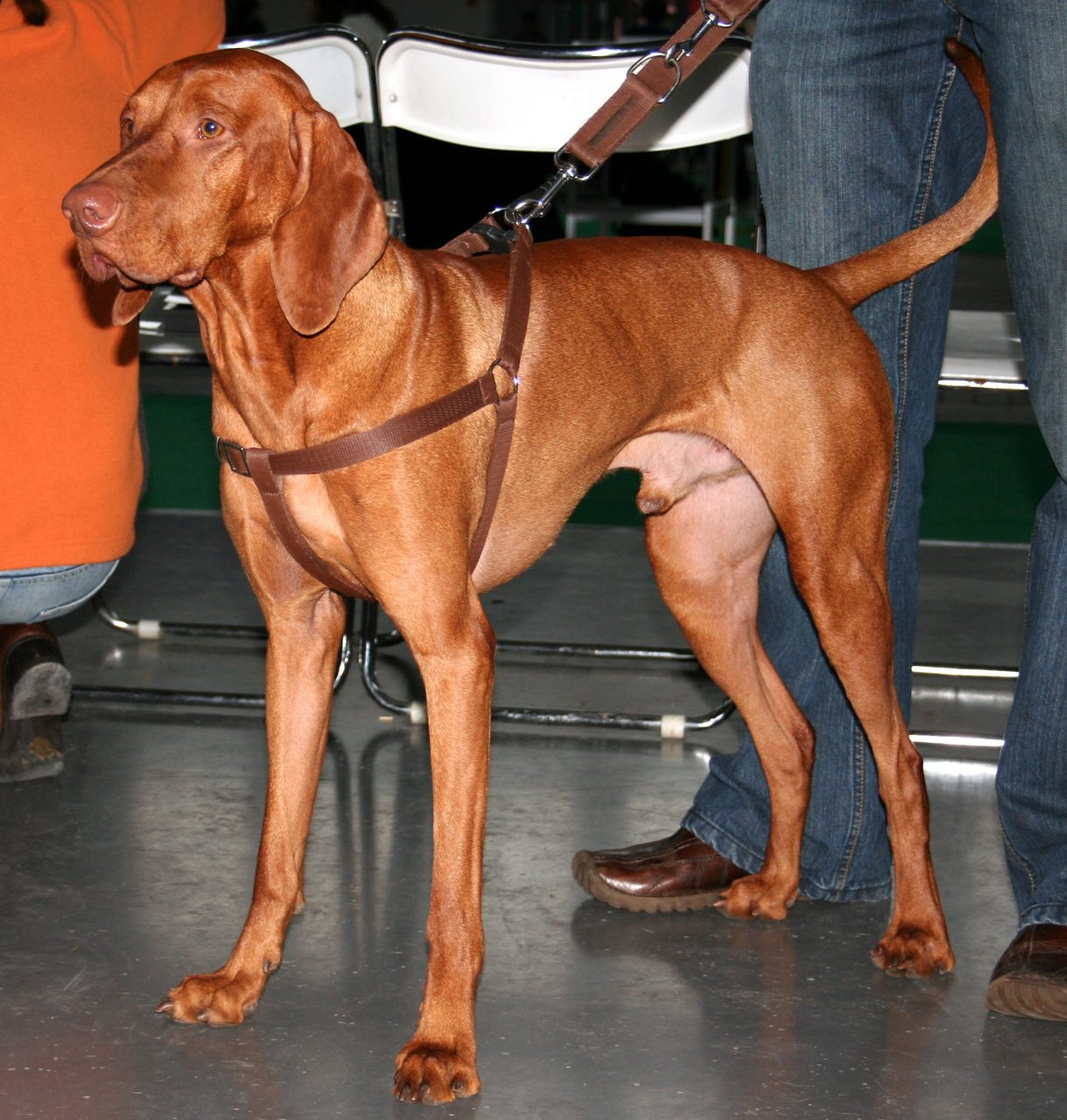
Vizslas are medium-sized working gundogs with high exercise demands and a lean genetic architecture. Feeding a Vizsla well means matching caloric density to their actual activity level and protecting against the rare PDK4-linked cardiac-risk variant that 1.6% of the breed carries (Donner 2023).
Energy balance is the breed’s defining nutritional challenge. Vizslas were bred for all-day hunting in warm climates and retain that metabolic expectation. A pet Vizsla in a suburban or urban home eating a standard maintenance kibble can become overweight if calories are not matched to actual activity, which compounds latent cardiac risk. Unlike Beagles, which were bred for steady eight-hour hunts and are food-motivated, Vizslas are lean hunters, their body condition should reflect that. Adult maintenance formulations should be measured carefully against body-condition score, not fed ad libitum. Work with your veterinarian to establish a target weight and caloric ceiling.
For the 1.6% of Vizslas carrying the PDK4-linked cardiac-risk variant, nutrition takes on additional importance. Taurine adequacy is critical. While the PDK4-linked cardiac risk signal in Vizslas is not yet well-characterized in the published literature, the precautionary default is a formulation that explicitly lists taurine supplementation and has undergone AAFCO feeding trials. This is the same conservative stance that the FDA and Adin et al. 2019 (JVIM) recommended for breeds with documented diet-associated DCM signals. A grain-inclusive adult formulation from a manufacturer with transparent nutrient profiling is the right starting point.
Vizslas’ lean frame and high metabolism mean skipping fasting days. Unlike some giant breeds that benefit from intermittent fasting protocols, Vizslas on high activity schedules do better with consistent daily calories split into two meals. Consistent meal timing supports stable energy levels in high-activity dogs.
Puppy feeding requires measured calcium intake. Medium-breed puppy formulations with calcium in the 0.8% to 1.2% dry-matter range (NRC 2006) support bone growth without acceleration that strains the growth plates. Vizslas grow to full size by 12 to 14 months; growth-phase nutrition is short but consequential.
What we don’t know
The penetrance of Factor VII deficiency in Vizslas remains unclear. Six of 33 dogs with two copies showed clinical signs in the Donner dataset, but clinical phenotyping is not always complete in screening cohorts. The actual frequency of bleeding episodes in carriers is unknown.
The breed’s cardiac landscape is largely uncharted. 1.6% of Vizslas carry the PDK4-linked DCM risk variant (Donner 2023), but the breed has no published longitudinal cardiac-screening data comparable to what exists for Cavalier King Charles Spaniels or Doberman Pinschers. The breed-specific penetrance of this variant, the typical age of onset, and whether diet modulates expression are all unknown. The absence of large-scale echocardiographic surveys in Vizslas means early cardiac disease may be underdetected or misattributed to other causes.
Exercise-induced collapse has not been reported in the Vizsla breed-club literature or the scientific record. The variant exists at low carrier frequency and showed zero phenotype-confirmed cases in the Donner cohort. It is not a breed-defining concern, but the silent-carrier status means screening breeding stock is a reasonable precaution.
Frequently asked questions about Vizslas
How long do Vizslas live? Cited life expectancy is 13.5 years (McMillan 2024 / VetCompass). Breed-club estimates vary with health and activity; individual dogs may live shorter or longer than the cited figure.
What is the most common genetic disease in Vizslas? None of the three Mendelian variants in the top list are common. All three are rare in the breed (carriers at 1.6%, 1.6%, and 0.94% respectively). Vizslas have a relatively clean genetic disease profile compared to many breeds.
Are Vizslas good with children? Vizslas were bred as hunting companions and are affectionate with family. They require significant daily exercise and mental stimulation and are most suitable for active households. They do well with older children; their high energy can overwhelm very young children.
Should I do a DNA test on my Vizsla? For breeding stock, yes. A panel covering the PDK4-linked DCM risk variant, EIC (DNM1), and Factor VII deficiency (F7) is recommended. For pet Vizslas, testing is optional but useful if there is family history of early cardiac disease or bleeding episodes.
What is the best diet for a Vizsla? A measured, calorie-controlled adult formulation matched to your Vizsla’s actual activity level is the priority. Avoid free-feeding; work with your veterinarian to maintain lean body condition. For the small percentage of Vizslas carrying the PDK4-linked cardiac-risk variant, a grain-inclusive formulation with explicit taurine supplementation and AAFCO feeding trials is the conservative choice.
Are Vizslas prone to hip dysplasia? Hip dysplasia data specific to Vizslas are limited in the published record. No Mendelian hip-dysplasia variants appear in the breed’s top list, suggesting low frequency of genetic predisposition. Standard OFA or PennHIP screening at two years of age is reasonable for breeding candidates.
What exercise do Vizslas need? Vizslas are hunting dogs and thrive on 1.5 to 2 hours of vigorous daily exercise. They bond intensely with their owners and are prone to separation anxiety if under-stimulated. They are not suitable for sedentary households.
Do Vizslas have any breed-specific coat or skin issues? No coat or skin conditions appear in the Mendelian variants table for Vizslas. Their short, dense coat requires minimal grooming. Skin health is best maintained through appropriate nutrition, exercise, and standard parasite prevention.