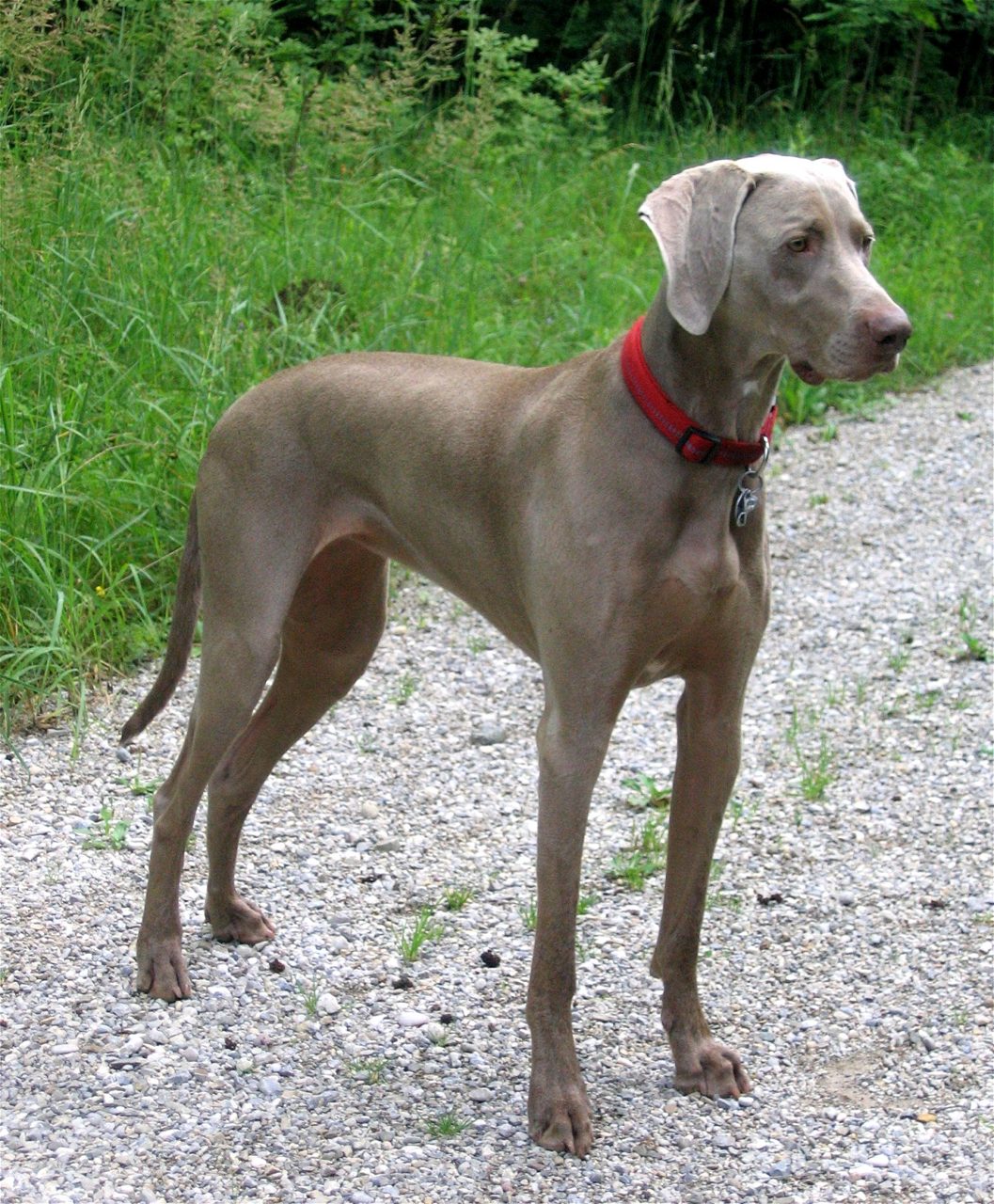
Which Mendelian variants matter most for Weimaraners?
The Mendelian-disease table above lists variants screened in 647 Weimaraners (Donner 2023). Four matter most by carrier frequency and clinical consequence. Two of them were discovered in Weimaraners and remain breed-defining.
Craniomandibular Osteopathy (CMO)
Craniomandibular osteopathy in Weimaraners is an autosomal-dominant condition affecting bone development in the lower jaw and skull. Affected dogs develop bony growths on the mandible and temporal bones, often causing pain, difficulty eating, and restricted jaw opening. CMO typically emerges in puppyhood; some affected dogs improve or stabilize, while others remain severely affected (Padgett & Mostosky 1986, JAVMA 188:855-857). CMO was discovered in Weimaraners. 16.1% of Weimaraners in the Donner cohort carry at least one copy (n=28). That is a high frequency for a dominant trait with significant impact on quality of life.
Testing is available through major commercial DNA labs. The Orthopedic Foundation for Animals maintains a registry for CMO screening. Because the trait is dominant, a single copy confers risk; breeding stock should be screened before pairing.
Hyperuricosuria (HUU)
Hyperuricosuria in Weimaraners is an autosomal-recessive condition causing elevated uric acid in the urine and increased risk of urate bladder stones. 14.6% of Weimaraners in the Donner cohort carry one copy (n=647). The Donner S4 dataset found zero phenotype-confirmed cases among at-risk dogs tested, which suggests either incomplete penetrance or that affected dogs are rare in the current population.
Dogs with two copies are managed with a urate-lowering diet (low purine, alkalinizing) and urinary monitoring. Testing is available. Carriers are heterozygous for risk but typically unaffected.
Cone-Rod Dystrophy (cord1-PRA/crd4)
Cone-rod dystrophy in Weimaraners is an autosomal-recessive progressive retinal atrophy with incomplete penetrance. Cone-rod dystrophy causes progressive vision loss beginning with cone-mediated (daylight) vision and later affecting rod-mediated (night) vision. 6.7% of Weimaraners in the Donner cohort carry one copy (n=646). The incomplete penetrance means not every dog with two copies will show clinical signs.
Testing is available through commercial labs and through the Canine Eye Registration Foundation (CERF). Ophthalmologic screening (CERF exam) remains the gold standard for phenotypic confirmation.
Hypomyelination
Hypomyelination in Weimaraners is an autosomal-recessive neurological condition affecting myelin sheath formation. Affected puppies are born with tremors, incoordination, and developmental delay; severity ranges from subtle to profound. The condition was discovered in Weimaraners. Carrier frequency is 0.93% (n=647), so affected pups are rare but possible from carrier-by-carrier pairings.
Testing is available. Because symptoms manifest at birth or in very early puppyhood, prenatal or neonatal diagnosis via genetic testing of breeding stock is the control point.
How should I test my Weimaraner?
A breed-specific panel from a CLIA-accredited lab covering CMO, hyperuricosuria, cone-rod dystrophy, and hypomyelination is the high-yield starting point for breeding stock. If hypomyelination or CMO appears in the line, testing becomes mandatory; both are high-impact conditions discovered in the breed.
What should I feed a Weimaraner?
Feeding a Weimaraner well begins with acknowledging the breed’s role as a high-drive gun dog. Weimaraners were bred for all-day hunting, and their metabolism reflects that. A pet Weimaraner eating a maintenance kibble in a suburban yard is being fueled for a different job than the breed was designed to do.
The breed carries two specific genetic feeding concerns: the 14.6% hyperuricosuria carrier frequency (Donner 2023, n=647) affecting urinary urate handling, and the CMO variant at 16.1% carrier frequency (Donner 2023, n=28) which can complicate puppy growth demands.
Puppyhood matters more for this breed than most. Weimaraners are a large breed, and steady growth to adult weight (typically 55-90 lbs depending on sex) is the target. Large-breed puppy formulations with controlled calcium (0.8%-1.2% on a dry-matter basis) and a calcium-to-phosphorus ratio between 1.1:1 and 2:1 are essential (NRC 2006). Fast growth increases the load on developing bones and joints; CMO’s prevalence in the breed makes steady, moderate puppy growth the safer target. Resist the temptation to over-feed for fast size gain.
Adult feeding should match activity level. The breed’s historical function was sustained high-drive work. A Weimaraner doing regular field work or competitive sport needs higher calories and fat than a sedentary pet. The difference is real and measurable; a working Weimaraner underfueled on a maintenance formula risks poor condition and energy deficits, while an inactive Weimaraner on a performance formula risks weight gain and associated joint strain. Honesty about your dog’s actual daily energy expenditure prevents the most common Weimaraner feeding failure: gradual weight creep and metabolic stagnation.
For carriers of hyperuricosuria, early dietary intervention prevents stones. Dogs with two copies benefit from a diet lower in purines (organ meats, certain seafoods) and pH-neutral to slightly alkaline. Prescription urate-management diets exist (Hill’s u/d, Royal Canin Urinary S/O) if a dog is at risk or has formed stones. Testing breeding stock for HUU status allows informed decisions about whether affected offspring warrant prophylactic dietary management from puppyhood onward.
The breed does well on both grain-inclusive and grain-free formulations. Weimaraners have not appeared in FDA diet-associated DCM case reports (FDA 2019 DCM update); the cardiac signal reported in Goldens has not been observed in this breed. Choose a formula appropriate to your dog’s activity level, with adequate taurine and tracked caloric density, rather than getting caught in the grain-free debate.
What we don’t know
The penetrance of hyperuricosuria in Weimaraners is genuinely uncertain. Donner S4 found zero phenotype-confirmed cases among the at-risk dogs in their cohort, yet the variant is present at 14.6% carrier frequency. The honest summary is we do not yet know whether affected Weimaraners remain asymptomatic, whether stones form rarely, or whether the variant’s disease expression is genuinely incomplete in this breed’s genetic background.
The same uncertainty applies to exercise-induced collapse, which appears in the screening panel at <0.1% carrier frequency with zero phenotype-confirmed cases. The variant exists in the breed. Whether it causes clinical collapse in Weimaraners remains unknown.
Weimaraners are built for high activity, yet we lack breed-specific epidemiology on orthopedic failure rates (hip dysplasia, elbow dysplasia, cruciate ligament rupture) or longitudinal data on how activity level modifies risk in this breed. Whether Weimaraners’ genetic relatives show meaningfully different dysplasia rates is not established in published breed-comparative data.
Frequently asked questions about Weimaraners
What is the most common genetic disease in Weimaraners? Craniomandibular osteopathy (CMO), a dominant bone-development disorder affecting the jaw and skull. 16.1% of tested Weimaraners carry at least one copy (Donner 2023, n=28). CMO was discovered in the breed and can cause pain and eating difficulty in affected puppies.
Should I do a DNA test on my Weimaraner? Yes, especially if breeding. A panel covering CMO, hyperuricosuria, cone-rod dystrophy, and hypomyelination is the standard. CMO is dominant, so a single copy warrants careful pairing decisions.
Can Weimaraners eat grain-free dog food? Yes. Weimaraners have not appeared in FDA diet-associated DCM reports (FDA 2019 DCM update); the cardiac signal seen in Goldens has not been documented in this breed. Choose based on activity level and ingredient quality rather than the grain-inclusion debate.
How long do Weimaraners live? Cited life expectancy is 12.8 years (McMillan 2024 / VetCompass, n=2,990, 95% CI 12.6 to 13). Individual dogs vary widely; breed-club records and longevity outliers are tracked on the breed’s atlas page.
What is the best diet for a Weimaraner? Match the diet to your dog’s activity level. A working Weimaraner needs higher calories and fat than a sedentary pet. Large-breed puppy formulations with controlled calcium are essential during growth. For carriers of hyperuricosuria (14.6% of the breed), a lower-purine, alkaline-leaning diet prevents urate stone formation.
Are Weimaraners prone to hip dysplasia? Breed-specific hip dysplasia rates are not well-characterized in published data. Breed-specific published data on Weimaraner dysplasia rates are limited; careful exercise modulation during puppyhood and adult joint monitoring are prudent given the breed’s activity demands.
What should I feed a Weimaraner puppy? A large-breed puppy formula with calcium controlled to 0.8%-1.2% (dry-matter basis) and a calcium-to-phosphorus ratio between 1.1:1 and 2:1 (NRC 2006). Steady, moderate growth is safer than fast size gain, especially given the breed’s 16.1% CMO carrier frequency.
Are Weimaraners good family dogs? Weimaraners are affectionate and bond tightly to their people, but they are high-drive hunting dogs built for all-day work. A pet Weimaraner needs consistent exercise and mental engagement; underexercised dogs develop frustration and destructive behaviors. They do well in active families and in homes where owners understand the breed’s work ethic.