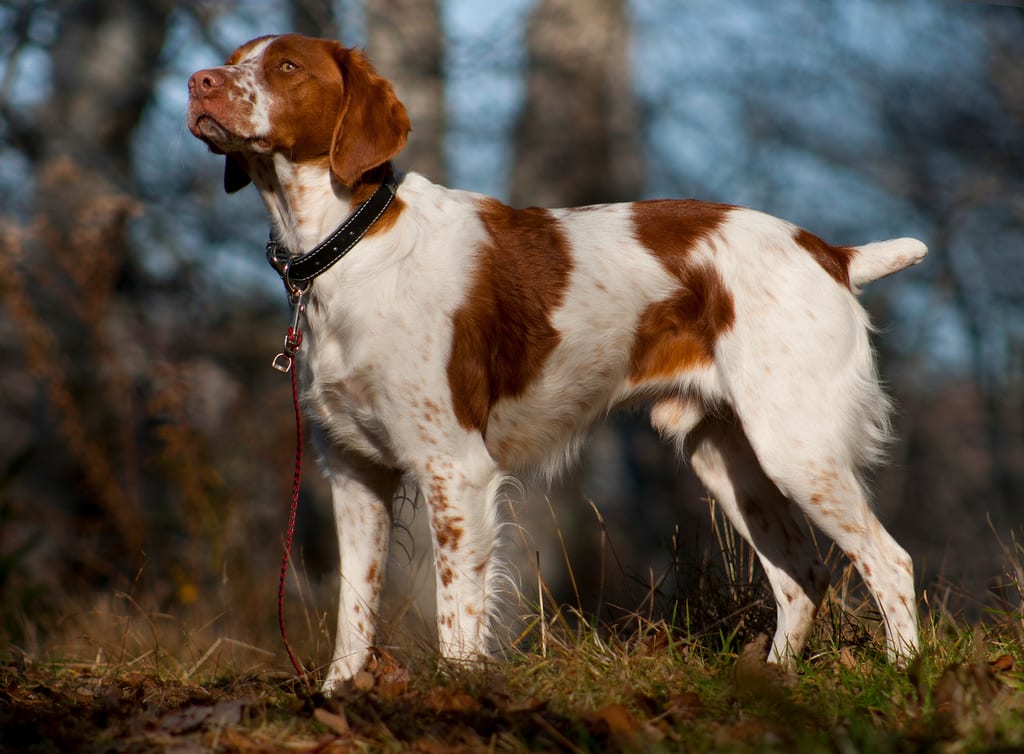
Which Mendelian variants matter most for Brittanys?
The Mendelian-disease table above lists four variants screened in 349 Brittanys (Donner 2023). All four are rare in the breed. The carrier frequencies are low enough that routine screening is not a first-tier concern for most Brittany owners.
Dilated Cardiomyopathy risk factor (PDK4-related)
Dilated cardiomyopathy risk in Brittanys is an autosomal-dominant finding with incomplete penetrance. The Donner 2023 panel labels this variant as PDK4-related (first characterized in Doberman Pinschers; OMIA:000162-9615). Affected dogs can develop enlarged, weakened hearts. Only 0.86% of Brittanys in the Donner cohort carry the variant (n=349). Testing exists and is available through most commercial DNA labs.
Cone-Rod Dystrophy (cord1-PRA/crd4)
Cone-Rod Dystrophy in Brittanys is an autosomal-recessive condition with incomplete penetrance. The disease causes progressive loss of sight, first in dim light, then in daylight. Carrier frequency is 0.43% (n=347). Not every carrier-by-carrier pairing produces affected puppies. Testing is available.
Degenerative Myelopathy (DM)
Degenerative myelopathy in Brittanys is an autosomal-recessive condition with incomplete penetrance. The disease causes progressive spinal-cord degeneration leading to hind-limb weakness and eventual paralysis. Carrier frequency is 0.14% (n=349). Testing exists and can guide breeding decisions.
Complement 3 (C3) Deficiency
Complement 3 deficiency in Brittanys is an autosomal-recessive condition. The disease affects the immune system, and affected dogs struggle with certain infections. Carrier frequency is 0.14% (n=349). Testing is available through specialty labs.
How should I test my Brittany?
The four variants above are rare enough in Brittanys that a breed-specific panel is not cost-effective for most owners. If you are breeding, a single-gene test for whichever condition runs in your lines is the pragmatic choice. Ask your breed-club health contact or your vet which variant, if any, has appeared in your pedigree. If you are buying a puppy, ask the breeder whether they have tested parents for the four conditions listed above. The honest answer is that most Brittany breeders do not test because the variants are so infrequent.
What should I feed a Brittany?
Brittanys were built for all-day hunting across fields and marshes. A pet Brittany eating maintenance kibble in a house is being fed for a job they are not doing. Cited life expectancy for the breed is 11.1 years (McMillan 2024 / VetCompass, n=991; 95% CI 10.9 to 11.3), which is solid for a sporting breed; the priority in feeding is sustaining the lean, athletic build the breed standard expects and protecting the joints that carry that frame through field work.
Large-breed puppy formulations are unnecessary. Brittanys weigh 30 to 40 pounds at adulthood. A standard puppy formula with a calcium-to-phosphorus ratio between 1.1:1 and 2:1 (NRC 2006) is appropriate. The growth rate is not extreme; overfeeding puppy-formulated calories is a more common mistake than underfeeding.
Activity level is the real caloric lever. A Brittany working four days a week needs more food than a Brittany sleeping on the couch. The breed’s sporting heritage means the metabolism is responsive to work. If your Brittany is active, feed to maintain visible ribs with a one-finger indent of fat over the ribcage. If your Brittany is a house dog, reduce portions accordingly to prevent creeping weight gain. The breed is prone to becoming overweight when overfed, and excess weight accelerates joint wear.
Joint support matters because Brittanys are high-impact athletes. The carrier frequency for degenerative myelopathy is low (0.14%, Donner 2023, n=349), but the breed’s field-work intensity means hip and elbow stress is real. Omega-3 supplementation from fish oil (EPA + DHA) has evidence for joint support in high-activity dogs. The NRC 2006 standard does not mandate it; breed-club experience supports it for working Brittanys. An adult maintenance kibble with joint supplementation, or a high-quality fish oil added to the regular diet, is a reasonable choice for a hunting dog.
Grain-free diets have no evidence benefit and possible cardiac risk. The FDA’s 2018 advisory flagged taurine-related dilated cardiomyopathy in dogs on certain grain-free, pulse-heavy formulations. Brittanys carry a PDK4-related DCM risk variant at 0.86% (Donner 2023, n=349), which is rare, but the breed is not immune to diet-associated cardiac disease. A grain-inclusive, taurine-adequate adult formula is the conservative default.
What we don’t know
The atlas cohort for Brittanys is small: 29 dogs. This is the honest limit of what the data can settle. The Donner 2023 screening (n=349) is larger and gives us solid carrier frequencies for the four detected variants, but 349 dogs is still a modest sample for a breed with thousands in the field.
We do not have Brittany-specific cancer prevalence data. The breed is not listed among the breeds with documented high cancer rates (like Goldens or Bernese Mountain Dogs), and no published cohort studies on Brittany mortality have been indexed. This does not mean cancer is not a concern; it means we have not systematically counted it in this breed.
Hip and elbow dysplasia are common in sporting breeds broadly. OFA does publish breed-specific hip and elbow statistics; check the OFA breed statistics page (ofa.org) for current Brittany figures. Ask your breeding prospect’s breeder for OFA or PennHIP scores on the parents; that is the actionable data point.
Frequently asked questions about Brittanys
Are Brittanys good for first-time dog owners? Brittanys are high-energy hunting dogs. They need daily exercise and do best with owners who understand the sporting-breed drive for activity and mental engagement. They are not good fits for sedentary households.
How long do Brittanys live? Cited life expectancy is 11.1 years (McMillan 2024 / VetCompass, n=991; 95% CI 10.9 to 11.3). Individual longevity varies with genetics, care, and lifestyle.
What is the most common health problem in Brittanys? The published data are sparse. Hip and elbow dysplasia are common in sporting breeds broadly, and joint wear from field work is the most frequent complaint among hunting Brittany owners. Ask your breeder for OFA scores on the parents.
Do Brittanys have genetic predispositions I should know about? Brittanys carry four documented Mendelian variants at low frequency (Donner 2023, n=349): a dilated cardiomyopathy risk factor (0.86%), cone-rod dystrophy (0.43%), degenerative myelopathy (0.14%), and C3 deficiency (0.14%). All are rare. Most Brittany owners will never encounter them.
Should I do a DNA test on my Brittany? If you are breeding, ask your breed-club health contact which variants, if any, run in your lines. If you are buying a puppy, ask the breeder whether parents have been tested. For pet owners, testing is not routine; the variants are too rare to justify screening cost.
What is the best diet for a Brittany? A grain-inclusive adult formula sized to maintain lean body condition is the standard. Activity level is the real dial: working Brittanys need more calories than house dogs. Omega-3 supplementation supports joints in high-activity dogs.
Are Brittanys prone to ear infections? Brittanys have pendant ears that can trap moisture, which is a general risk factor for otitis in dogs with drop ears. Regular ear cleaning after water exposure is routine preventive care. This is not genetic; it is breed anatomy.
What should I expect at the vet? Annual exams are standard. Request OFA or PennHIP hip screening before breeding. Ear checks are part of routine wellness. Heart murmurs should be evaluated; the PDK4-related dilated cardiomyopathy risk variant is rare (0.86%), but the breed is not immune to cardiac disease.
Related reading
- Grain-Free Dog Food and DCM
- Sniff’s Dog Food Methodology
- How We Estimate Lifespan
- Weimaraner, nearest genetic relative
- Irish Water Spaniel, nearest genetic relative