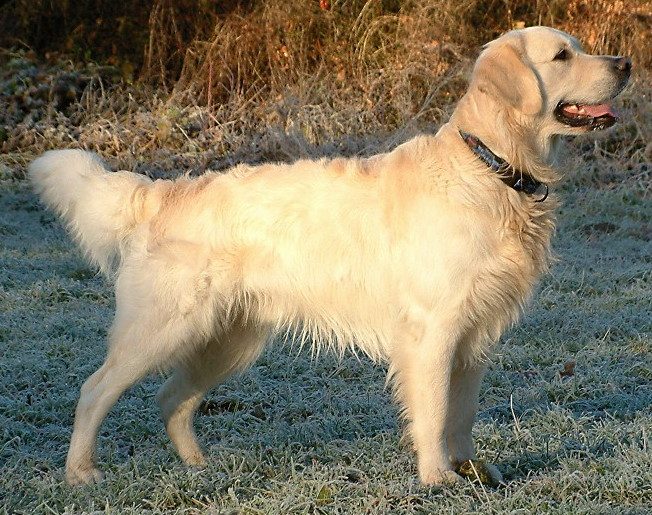
Which Mendelian variants matter most for Golden Retrievers?
The Mendelian-disease table above lists 195 variants screened in 12,881 Goldens (Donner 2023). Five matter most by carrier frequency, and the first two matter most by impact.
Ichthyosis (PNPLA1)
Ichthyosis in Goldens is a recessive skin condition caused by a deletion in PNPLA1. Affected dogs have flaky, scaly skin that gets worse with age. It is cosmetic and manageable, not life-threatening. About 27.5% of Goldens in the Donner cohort carry the variant (n=12,881). More than one in four. It is the most common Mendelian variant in the breed and the single most consequential number on this page.
Testing is widely available. The PennGen Laboratory and most commercial DNA labs cover PNPLA1. The Golden Retriever Club of America’s health committee recommends testing breeding stock to avoid carrier-by-carrier pairings. For pet dogs the test is informative but not clinically required.
Cystinuria Type I-B (SLC7A9 p.A217T)
Cystinuria Type I-B in Goldens is the autosomal-recessive-with-incomplete-penetrance form of cystinuria. The SLC7A9 variant causes excess urinary cystine excretion and predisposes to bladder stones. 23.7% of Goldens in the Donner cohort carry the variant.
Not every dog with two copies forms stones, which is why the inheritance is described with incomplete penetrance. Testing is available. Affected dogs are managed with diet (low-protein, alkalinizing) and monitoring. Owners of carrier dogs should mention the result to their vet at routine visits even if their dog never shows symptoms.
Retinal atrophy variants (TTC8, PRCD, SLC4A3)
Three progressive retinal atrophy variants run at observable frequency in Goldens. The TTC8-related form is at 2.8% carrier frequency, PRCD (progressive rod-cone degeneration) at 2.7%, and the SLC4A3-related form at 1.6%. All three are recessive: a dog needs two copies to be affected, and affected dogs are well below 1% of the breed.
Affected dogs lose night vision first, then day vision, typically beginning in middle age. The OFA Companion Animal Eye Registry maintains the screening protocol. The GRCA recommends annual eye exams for breeding stock.
How should I test my Golden Retriever?
A breed-specific panel from a CLIA-accredited lab is the high-yield path. The minimum useful set for Goldens is PNPLA1 (ichthyosis), SLC7A9 (cystinuria), PRCD, TTC8 (GR-PRA2), SLC4A3 (GR-PRA1), and MDR1. Most commercial panels also include ten to fifteen additional Golden-relevant variants in a single draw. For breeding stock the GRCA’s recommended panel is the current standard. For pet dogs the same panel is informative but not clinically required.
What we don’t know
Cancer is the breed’s defining health problem. Roughly 60% of Goldens die of cancer (Morris Animal Foundation GRLS), one of the highest rates of any breed. Hemangiosarcoma and lymphoma together account for more than half of GRLS cancer diagnoses. The Golden Retriever Lifetime Study has spent fourteen years looking for environmental, dietary, and genetic predictors. The honest summary is that the published analyses have come back mostly null. We do not yet have proven dietary prevention strategies for cancer in this breed. The data the GRLS cohort is producing will sharpen that picture in the next few years.
Frequently asked questions about Golden Retrievers
Are Golden Retrievers more likely to get cancer than other breeds? Yes. Roughly 60% of Goldens die of cancer (Morris Animal Foundation), one of the highest rates of any breed. The four dominant cancers are hemangiosarcoma, lymphoma, osteosarcoma, and mast cell tumors. The published environmental and dietary analyses from the GRLS cohort have come back mostly null so far, which means proven prevention strategies are not yet available.
What is the most common genetic disease in Golden Retrievers? Ichthyosis, caused by a variant in PNPLA1. 27.5% of Goldens carry one copy and roughly 7.6% are affected (Donner 2023, n=12,881). It is a cosmetic skin condition, not life-threatening, and is the most common Mendelian variant in the breed.
Should I do a DNA test on my Golden Retriever? For breeding stock, yes. The GRCA recommends a panel covering ichthyosis, cystinuria, the three retinal atrophy variants, and MDR1 at minimum. For pet dogs, testing is informative but not clinically required. The highest-yield single tests are PNPLA1 (ichthyosis) and SLC7A9 (cystinuria).
How long do Golden Retrievers live? The breed-club estimate is 10 to 13.2 years (McMillan 2024 / VetCompass) (Morris Animal Foundation). The atlas-derived figure from the GRLS cohort is 13.15 years, but that median will shift downward as the cohort completes its lifespan. Both numbers belong on this page. The breed-club figure is closer to what an owner should expect today.
Are field-line and show-line Goldens genetically different? The Sniff atlas substrate currently classifies Goldens as a single genetic cluster with an intra-breed RMS distance of 35.8. Show-line and field-line Goldens may differ at finer resolution than the substrate currently captures. Higher-resolution data arriving later this year will resolve this question one way or the other.
What is the GRLS and why does it matter for Golden Retrievers? The Golden Retriever Lifetime Study is a fourteen-year longitudinal study of 3,044 Goldens run by the Morris Animal Foundation. It is the most detailed map of canine health ever assembled in any breed. Sniff is not affiliated with the Morris Animal Foundation. The cohort’s data is what makes the lifespan median, the cancer rate, and the Distinguished Oldies count on this page possible.